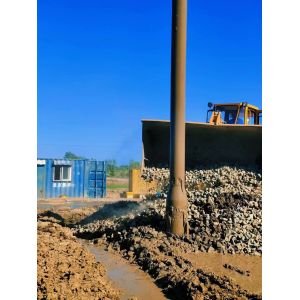
Comparative Analysis of Vibroflotation Equipment Series 1
In the field of vibroflotation equipment, products of different
technical types and models exhibit significant differences in
performance parameters and application scenarios. This analysis
compares four vibroflotation equipment models—BJVE-426-180
(conventional electric), BJVE-450-260 (conventional electric),
BJVH-350-150 (hydraulic), and BJVEF-450-225 (electric
variable-frequency)—to provide professional references for
equipment selection decisions.
Main Parameter Comparison
| Vibro Model | Electric Normal
BJVE-426-180 | Electric Normal
BJVE-450-260 | Hydraulic
BJVH-350-150 | Electric Frequency Conversion
BJVEF-450-225 |
|---|
| Diameter (mm) | 426 | 450 | 350 | 450 |
| Power (kW) | 180 | 260 | 150 | 225 |
| Speed (rpm) | 1450 | 1450 | 2600-2900 | 1450-1740 |
| Centrifugal Force (kN) | 280 | 440 | 250-350 | 520 |
| Max. Amplitude (mm) | 22 | 26 | 11 | 20 |
Comparison of Core Parameters: From Specifications to Power
Performance
1. Differences in Basic Specifications
Diameter: The diameters of the four models vary significantly, ranging from
350mm (BJVH-350-150) to 450mm (BJVE-450-260 and BJVEF-450-225),
with the BJVE-426-180 measuring 426mm. Diameter directly affects
the equipment's adaptability to the operating environment.
Larger-diameter equipment offers a wider deep vibration influence
range and compaction scope, while smaller-diameter models provide
stronger penetration, greater flexibility, and produce smaller pile
diameters.
Power: Power ranges from 150kW (BJVH-350-150) to 260kW (BJVE-450-260).
The electric variable-frequency model BJVEF-450-225 has a power of
225kW, and the conventional electric model BJVE-426-180 has 180kW.
Power determines the equipment's vibration output capacity and
continuous operating intensity.
2. Power and Vibration Performance
Speed: Conventional electric models BJVE-426-180 and BJVE-450-260 have a
fixed speed of 1450rpm, classified as constant-speed vibroflotation
equipment. They are mostly used in common soft soil foundation
treatment projects.
The electric variable-frequency model BJVEF-450-225 features
adjustable speed (1450-1740rpm), allowing flexible adjustment of
vibration frequency according to operational needs. It is suitable
for soft foundations with shallow hard soil layers.
The hydraulic model BJVH-350-150 has a wide speed range
(2600-2900rpm). Its high speed enables faster vibration frequency,
making it suitable for complex hard soil layers.
Centrifugal Force: Centrifugal force is the core embodiment of the equipment's
"exciting force". The BJVEF-450-225 leads significantly with 520kN,
followed by the BJVE-450-260 (440kN), the BJVH-350-150 (250-350kN
range), and the BJVE-426-180 (280kN). High centrifugal force means
the equipment can more efficiently handle high-resistance,
high-load vibration operations (such as deep foundation compaction
and penetration capacity in hardness soil layer).
Maximum Amplitude: Amplitude determines the "influence width" of vibration. The
BJVE-450-260 has the largest amplitude at 26mm, followed by the
BJVE-426-180 (22mm), the electric variable-frequency model
BJVEF-450-225 (20mm), and the hydraulic model BJVH-350-150 (only
11mm). Equipment with large amplitude provides a larger radius of
influence on soil compaction around the vibration area during
foundation compaction construction.